
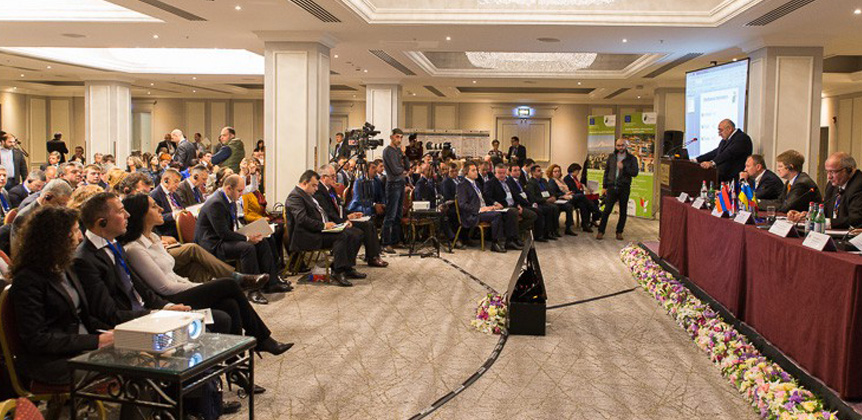
Vetka, Vilejka, Orša, Šarkaŭščyna, Kličaŭ and Mahilioŭ joined the European Covenant of Mayors initiative. The authorities of these towns signed the declaration at an international conference on “Fostering sustainable development in Eastern Partnership countries” in Yerevan. Joining the Covenant of Mayors, they declare their commitment to implementation of the EU climate and energy goals, one of which is a 30 % reduction in CO2 emissions by 2030, while the EU is going to give grants and cheap loans.
Why Do We Need the Covenant of Mayors?
The whole world is concerned about the climate change. One of the prerequisites to slow down these changes is reduction in CO2 emissions. Different countries have different ways of spending their resources to reduce greenhouse gases emission. The Covenant of Mayors is an EU initiative to help cities and towns reduce CO2 emissions and adapt to the climate changes. To do this, the EU finances energy efficiency programmes both through grants (gratuitous help) and through cheap loans for investors. The initiative aims solely at local authorities and projects with budgets of a few tens of thousands to millions of euros.
Surely, even a fully heat-insulated town that consumes little energy is not going to contribute greatly to the global CO2 balance. But the picture changes, if we consider that more than 7000 mayors have already signed up for the initiative! The total population of the signatory cities is over 200 mln people. Given the fact that 80 % of CO2 is emitted by cities and towns regardless of their size, the total “weight” of the members is quite high even in absolute terms. The Covenant of Mayors initiative began in 2008 and aims at a 20 % emission reduction by 2020.
· 16 Belarusian towns joined the Covenant, 10 of them being in the active phase.
In 2014, the Mayors Adapt campaign set a goal of adapting cities to climate change. In 2015, both initiatives merged into a comprehensive Covenant of Mayors for Climate and Energy programme, including new objectives: minus 40 % of CO2 by 2030. But given the capabilities of the Eastern Partnership cities, the objectives were reduced to the minimum of 30 %. In Yerevan, 6 Belarusian towns have signed the declaration of accession to this particular document. Thus, the number of signatories from our country reached 22.
What About the Money?
It will be given, but not just like that, it will still have to be “earned”. The first thing local authorities will need to do is to draw up Sustainable Energy and Climate Action Plans for their towns. As part of them, specific energy efficiency (and, potentially, adaptation) projects may be developed, for which economy loans can be granted.
To support the members of the Covenant, a 10 mln euro grant programme is provided for 6 countries of the Eastern Partnership. Belarus will most likely get the gratuitous help of around 2 mln euro. The European Commission is going to review project applications, allocating grants on a competitive basis. This is a good incentive to develop the projects thoroughly.
In addition to addressing global climate protection challenges, each individual town enjoys a number of benefits. The energy development plan is useful not only for the Covenant of Mayors grant programme. The document gives the local authorities an ”energy course” and understanding of the steps the town should take to achieving sustainable development and the order they should be taken in. This will simplify implementation of other energy efficiency projects and the search for their investors.
Whom a Belarusian Town Mayor Can Expect Help from?
Interakcia Foundation experts support the initiative in Belarus. The foundation is a member of an international consortium implementing the EU Covenant of Mayors East project and facilitating popularisation of the idea locally, regionally and nationally. For instance, the foundation took part in drawing up the Sustainable Energy Action Plan for Polotsk, said Ivan Shchedrenok, a Covenant of Mayors national expert for Belarus.
Moreover, IPO “Ecopartnership” has gained a status of a Covenant supporter at the conference in Yerevan. From now on, it will also provide experts to support the initiative in Belarus. The main goal is to develop cooperation between NGOs and local authorities on the issues covered by the Covenant.
What Projects are Relevant for Our Towns?
To achieve the priority goal of CO2 emissions reduction, towns develop their energy plans. The initial projects for all Belarusian localities are practically the same: energy efficiency events, insulation of municipal buildings, city lighting and transport. All these areas can give maximum energy savings per unit of the funds spent.
“Heat insulation, windows, heating lines… The same principles governed the construction of our towns. That’s why the problems they face are almost the same,” explains Ivan Shchedrenok. “If we compare the topics of the projects, we will see they are quite similar really. Demonstration projects support programme financed by the EU aims at helping towns implement the best of them. This will show other towns the innovations in the sector.”
The projects in Polack (LED city lighting), Chavusy (consumed water and energy accounting automation system), and Braslaŭ (the first climate neutral area in Belarus) were part of the previous version of the programme (minus 20 % by 2020).
The new Covenant of Mayors (by 2030) adds a climate component to the Sustainable Energy Action Plans: now measures are to be developed for the towns to adapt to climate change. Once the document has been drawn up, each locality can choose the most relevant energy efficiency and adaptation projects. If a project is quite innovative and could set an example for other towns, it has a good chance of being financed through a grant (gratuitously).
What of the Mayors?
The prospect of receiving investment (including grants), reducing power consumption of their towns and improving the quality of life for their residents, should definitely be attractive for local authorities. Mayors (in our country, they are the chairmen and deputy chairmen of the district and town executive committees) are getting proactive. 13 district executive committee representatives attended the conference in Yerevan, 6 of them signed the new Covenant.
“Our region is distinguished by the cleanliness of its environment and low energy consumption,” says Alexey Polovikov, deputy chairman of Klichev District Executive Committee. “Almost 60 % of the area is covered by forests and high marshes which suffer from climate change towards continentality. Agriculture suffers too. We expect the Covenant to bring ideas and resources, which will enable us to implement the climate mitigation projects. And given the area’s high dependence on subsidies, we lack budgetary funds for energy efficiency. There is an opportunity to implement energy efficiency projects. For example, if we replace the lamps with LEDs, we will be able to increase the city lighting duration spending the same amount of money.”
“We would like to learn something from this Covenant,” says Nicolay Bogovich, chairman of Sharkovshchina District Executive Committee. “People working on energy efficiency projects in their regions are said to learn lots of useful information, raise their proficiency level. Thanks to the Covenant, we will indeed try to better understand the challenges we are facing. And surely, it would be good, if our programme is deemed worthy of attention. Especially, if the European money helps us implement our energy efficiency project. I believe everyone here [regional authorities representatives] is pursuing this goal.”
Mayors of Georgia, Moldova, Ukraine cities and towns that have reached different stages of their energy efficiency programmes implementation, had the floor at the conference. The representatives from Čavysy, and Polack (Belarus) shared their experience too (this will be covered in one of the upcoming articles).
How are the Neighbours Doing?
And our neigbours are not sitting idly by. While Belarus has 16+6 members of the Covenant, the small Moldova has 34, and Ukraine can in fact boast of 142! Considering the fact that the first signatories from Ukraine and Belarus appeared almost at the same time, such a difference is quite disheartening. However, it can be easily explained.
“The Association of Energy Efficient Cities of Ukraine has started to actively promote the Covenant of Mayors,” explains Ivan Shchedrenok. “The Ukrainian cities and towns did not have such a strong state-run energy efficiency programme as we did, so, to solve the energy efficiency issues, they started using the principles stipulated by the Covenant. While our localities have been developing energy efficiency in the framework of national programmes.”
Thus, Belarusian cities and towns do not have to start their energy efficiency work from scratch, some progress has been achieved already. The main task for our signatories now is to draw up their own sustainable energy and climate action plans within the next 2 years. These should feature energy efficiency projects. The best of them have the chance to set an example and get a grant.


