
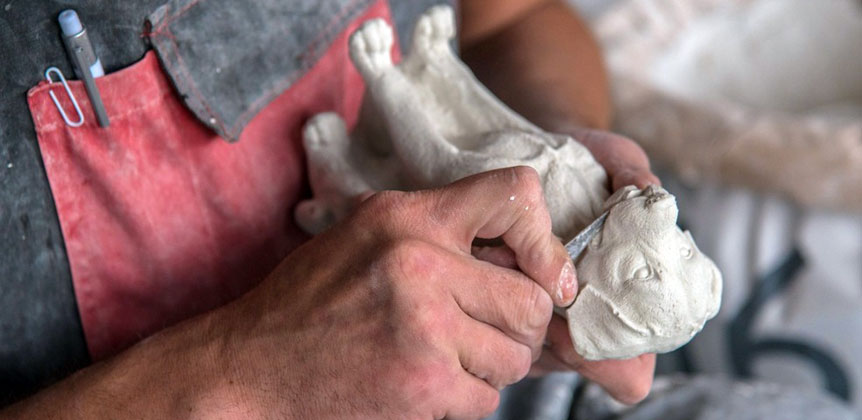
The Social Workshop opened its doors almost a year ago in Smaliavičy, a district centre northeast of Minsk. It was created to help people who wanted to get rid of their alcohol and drug dependence by offering them a job that would guarantee them a monthly income, and the ability to communicate with peers who would treat them with respect and understanding, says project manager Vladislav Kovrov, who is also head of the public organisation ‘Healthy choice.’
The most important is to achieve a sustainable result
Initially, the Social Workshop project, funded by the European Union, ran from February-June 2016. But since the initiative proved successful, the workshop continued its operation.
“We have achieved initial success, and now strive to become a commercially successful enterprise. We sell plaster figurines, that are handmade in the workshop, and also organise charity events,” explains Kovrov. According to him, the uniqueness of the project lies in the use of a self-help group method, bringing together people with the same problem: communicating with each other, they help each other.
“Among the workers in the Workshop there are those who have managed to restore their parental rights and have already taken their children out of an orphanage. At the moment, they have to pay off the debt to the orphanage – which is up to 70 per cent of their monthly earnings. Project participants can earn 200-300 dollars per month, but this is not the main incentive for them,” says Kovrov. The craftsmen confirm this – each has struggled to overcome their alcohol addiction, and for them it is important to work in a circle of people who understand them as they have had similar problems. According to them, stopping drinking or drugs is only a first step: the next is to learn how to live differently and to deal with negative emotions.
‘In Belarus it is difficult to survive after you have quit drinking’
“In Belarus it is difficult to survive after you have quit drinking and have stayed sober for a while after that,” admits Vladimir, a 52-year old craftsman who works in the Workshop. “Recovering drinkers feel excluded; it is difficult for them to find a job. This leads to anger, aggression, and sometimes frustration, and they start drinking again – this is a vicious circle,” he says.
Nine years ago, Vladimir moved to Smaliavičy from Minsk, where, as he says, he “drank away” his 3-room apartment. His past was a nightmare. He started drinking at the age of 15 after his mother's death. His farther, who was an alcoholic, died when Vladimir was 21. Then he got married but could not quit drinking, and 10 years later his wife left him with their two daughters. He worked as a driver, then as a fitter at most all of the factories in Minsk – everywhere he was valued as a good worker, and his employers closed their eyes to his addiction, but eventually he had to resign from every place he worked.
“I stopped drinking 11 years ago, and I was cured thanks to a self-help group where I learned about this Social Workshop,” says Vladimir. According to him, the atmosphere in the Workshop gives hopes for a normal life. “We help each other, we see the results, there are people with the same past experience as us – from Žodzina, Minsk, and Barysaŭ – who come to visit us here. I am sure that such communication and teamwork help to change lives, if not of everyone, at least of many of us.”
‘I talk about my past to help others’
A 35-year-old resident of Smaliavičy, Valery shares his story without fear and in hope that it will help others. Valery’s life was burdened with various problems, when he learned about self-help groups, and there about the Social Workshop project.
“I come from a good family, my parents are respected people in my town. I realised that I was causing them horrendous misery, but I couldn’t stop. My story is the classic of the genre: I started with drinking, continued with soft drugs and added gambling to it. It all started at the age of 14 with alcohol, then later drunkenness made me fly, it made me feel a leader. After graduating from the 9th grade, I went to a vocational school, at that time I also started using soft drugs.”
Valery had repeatedly decided to change his life. He hoped to get rid of his bad habits in the army, but there, he says, "I asked to work in a boiler room, and during the night I went out to buy liquor, and I went back to the way thing had been before." After the army, Valery decided that only the responsibility for his own business could break the vicious circle. "My parents helped me to open a retail outlet in the market, I bought a car. Things went well, but not for long. In the company of my new friends you were not considered 'cool' if you were drinking – smoking pot was their standard. I started pouring money down the drain, and my business went bankrupt."
The next attempt to get rid of his dependence was marriage. ‘I thought that the responsibility for the family would stop me. My daughter was born two years later. But instead of quitting, I started gambling. At that time, banks were giving 'quick loans', and I ran headlong into debt, and my family left me. In 2009, I committed a petty crime and was sent to jail. When I was granted parole and my family welcomed me back, I was determined to break with the past.”
But Valery broke his word. He had to leave the family. “One day I woke up, sitting on the side of the road in Minsk. Without any money. Going nowhere. I couldn't go to my parents – mother's tears were unbearable,” that is how Valery describes the last episode (and this time he is sure about it) of his past life. At that point, he thought of suicide. “I went to say goodbye to my mother, and she persuaded me to receive treatment in a rehabilitation centre. There I was introduced to a group of anonymous alcoholics, and then I learnt about the organisation ‘Healthy Choice’. That's how I joined the Social Workshop, which helps me to live.”
Valery hasn’t been drinking for three years, but only after he had joined the Workshop, did his confidence return to him. “I will never go back to my past. I am forever grateful to the creators of the Workshop – thanks to them I can feel normal again. Today I live without fear to meet old 'friends', I know how to talk to them, I am sure that there is support – it is in people who work with me. I returned to my family, and I managed to restore my good relationship with my wife, 10-year-old daughter and other relatives.”
Valery says the Social Workshop project is helping nearly 100 people. And he praises it as a good example of the developing culture of social entrepreneurship in Belarus, one he hopes can be replicated across the country.
By Elena Daneiko for the project UNeighbours East.
**************************************************
A local initiative, the 'Social Workshop' has been implemented since January 1, 2016 in the framework of the project ‘Promotion of local development in Belarus’ supported by the European Union, the Ministry of Economy of the Republic of Belarus and the United Nations Development Programme (UNDP). This initiative aims to develop and implement non-standard models of support for recovering alcoholics and their families in the Smaliavičy district.


