
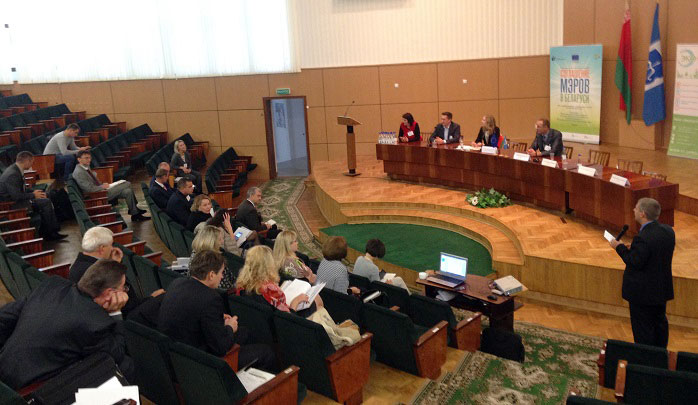
On October 5-6, 2016, representatives of 16 Belarusian cities attended a training workshop on the impact of climate changes on urban economy. They learned to assess the risks and found about the option of getting financial support within the European initiative 'Covenant of Mayors for Climate and Energy'. The event was arranged by Ecopartnership (an international NGO) and the Brest City Executive Committee.
The event was attended by representatives of the cities that planning to accede or have acceded to the Covenant of Mayors for Climate and Energy. Participation in the European initiative implies fulfillment of a number of commitments to mitigate greenhouse gas emissions. At the same time, it offers additional opportunities for the cities in terms of encouraging international investments.
At the event opening ceremony, Ms. Yulia Yablonskaya, Ecopartnership Chairperson, emphasized that the cities' efforts on local-level mitigation of greenhouse gas emissions is consistent with the Belarusian climate policy. By signing the Paris Agreement on Climate Changes, the country undertook to reduce greenhouse gas emissions by 28% by the year 2030.
Mr. Ivan Schedrenok, a national expert of the East-II Covenant of Mayors informed the attendees about stages of the European climate and energy initiative as well as its accession mechanism.
Mr. Alexander Rogachuk, Chairperson of the Brest City Executive Committee, expressed his confidence that Brest will work on mitigation of greenhouse gas emissions. The city signed the Covenant of Mayors for Climate and Energy now it is developing the required documentation – a register of greenhouse gas emissions, and climate changes risk assessment.
At the workshop, the city representatives described in detail the causes and effects of climate changes, key risks and suggested adaptation measures.
- Belarus is 'liable' for less than 1% of global greenhouse gas emissions. However, experts of the International Bank for Reconstruction and Development classify it as a relatively highly weather-dependent economy – noted Mr. Oleg Tokarchuk, a professor of Brest State University by Name of Pushkin.
In his speech, he dwelled on risks for such spheres and utilities, transportation and healthcare. Thus, water delivery to residents of settlements without central water supply may reduce due to recession of top aquifer level.
Mr. Vasily Molochkov, Chairperson of Technopark-Mogilev CJSC, explained the ways of developing measures to adapt the city for the requirements of the Covenant of Mayors for Climate and Energy.
The workshop participants included representatives of such Belarusian cities that have been working successfully for a number of years in the area of energy efficiency and urban economy adaptation to climate changes. They had an opportunity to share their experience with their colleagues at discussions.
The experience of Ukraine on activities within the Covenant of Mayors for Climate and Energy was also presented at the event. Ms. Mariana Prystupa, Deputy Director of the Ukraine Energy Efficient Cities Association, explained, how the energy management system was developed in Ukrainian cities. It included such stages as setting of the energy policy target and objectives, development of guidelines and instructions for the energy manager, establishment of an energy task team.
- Development and introduction of an energy management system is just the beginning, while regular compliance checks will be the factor of continuity of improvements, - emphasized Ms. Mariana Prystupa.
On the second day of the workshop, the participants made a visit to the Brest Waste Treatment Plant, Wood Waste to Biofuel Processing Facility at Kommunalnik PMUE, 'Katin Bor' Boiler Plant and the Western Water Intake, where they learned about advanced 'green' technology.
The training workshop was held under the EU project 'Support to the Covenant of Mayors Initiative in Belarus', which is implemented by Ecopartnership.


